AI agent usage in the workplace has nearly doubled since last year, jumping from 31% to 59%, but full autonomy remains off the table for most. While enterprise leaders are leaning into the operational benefits and worrying less about costs, 63% of technologists still rarely or never let agents run entirely on autopilot. Instead, the industry is settling into practical, single-agent workflows where human review remains the gold standard. Leaders say the positive side of agents overshadows concerns about costs, accuracy, and security, while developers maintain that security and accuracy are still major concerns regardless of improvements in work quality.
Here is a look at the data behind the adoption boom, the tools winning the race, and why industries like fintech are leading the charge. 1,100 developers and working professionals responded to the survey from late April.
Agents Are Mostly on a Leash
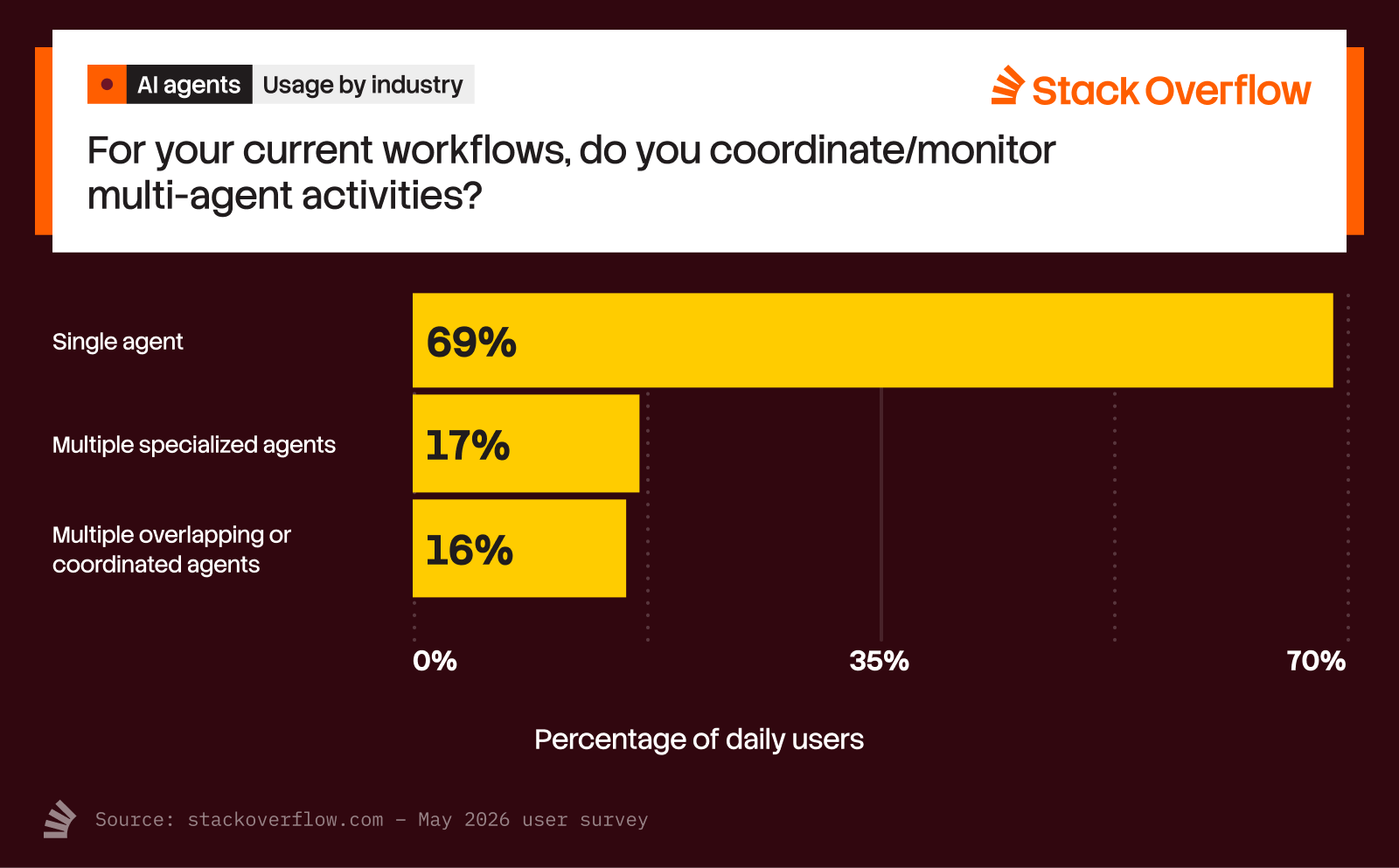
Full autonomy is a risk agentic users are not willing to take. Most (60%) of survey respondents block agents from making unapproved system changes, and 68% prefer predictable, single-agent setups over complex, multi-agent configurations. The single-agent workflow of choice for the majority of respondents — primarily full-stack developers — is GitHub Copilot (65%) or Claude Code (50%).
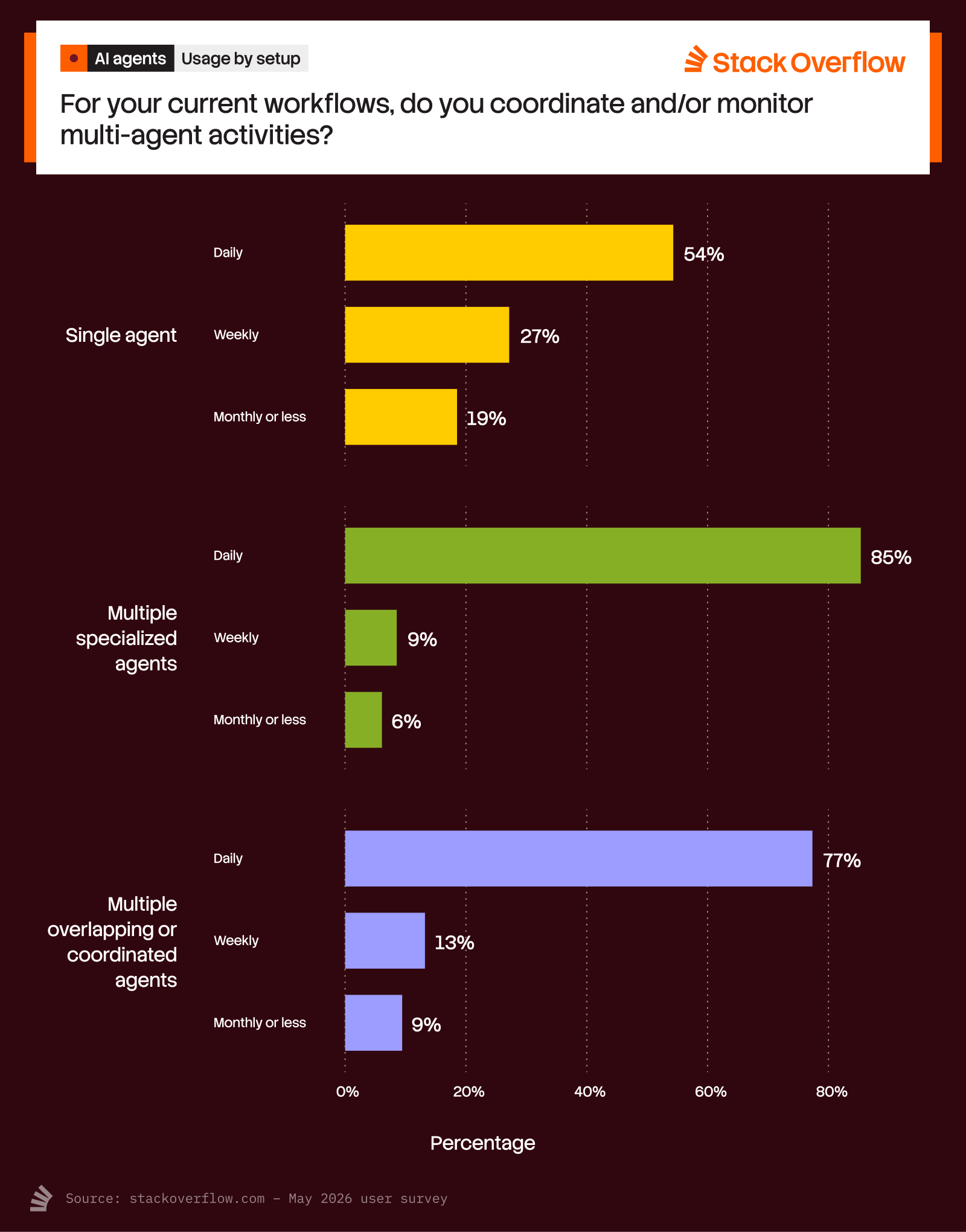
Developers are still part of the process for coding, and they have been more skeptical about accuracy since Stack Overflow started asking about it in 2023. While fewer people use multiple specialized agents or orchestrated multi-agent systems, those who do orchestrate multiple agents use agentic workflows daily more than single-agent users. These daily multi-agent users rely on Claude Code the most (70%), but also build DIY setups using frameworks like the OpenAI SDK (18%) and vector databases like ElasticSearch (17%).
Adoption Has Nearly Doubled Since Last Year
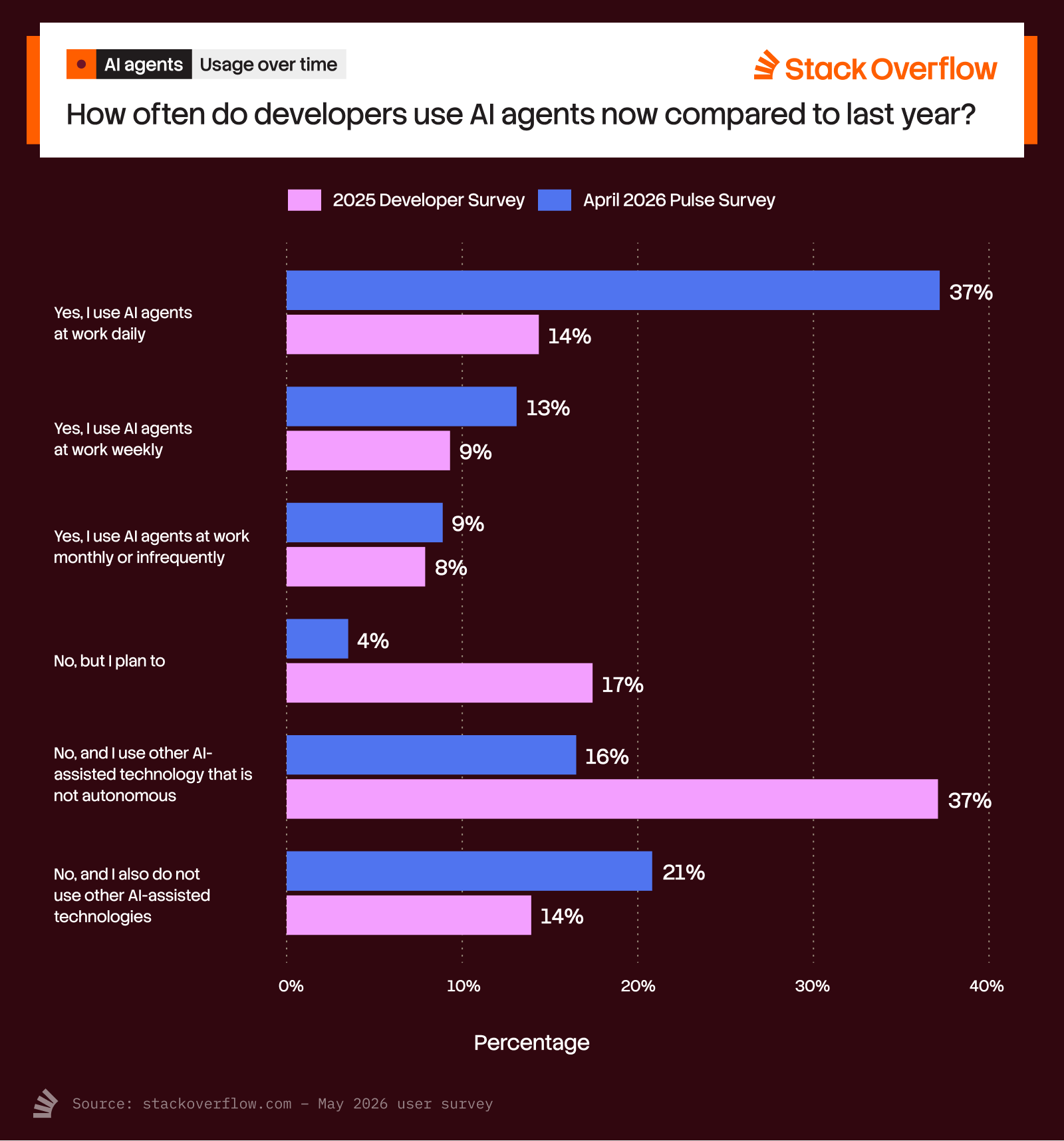
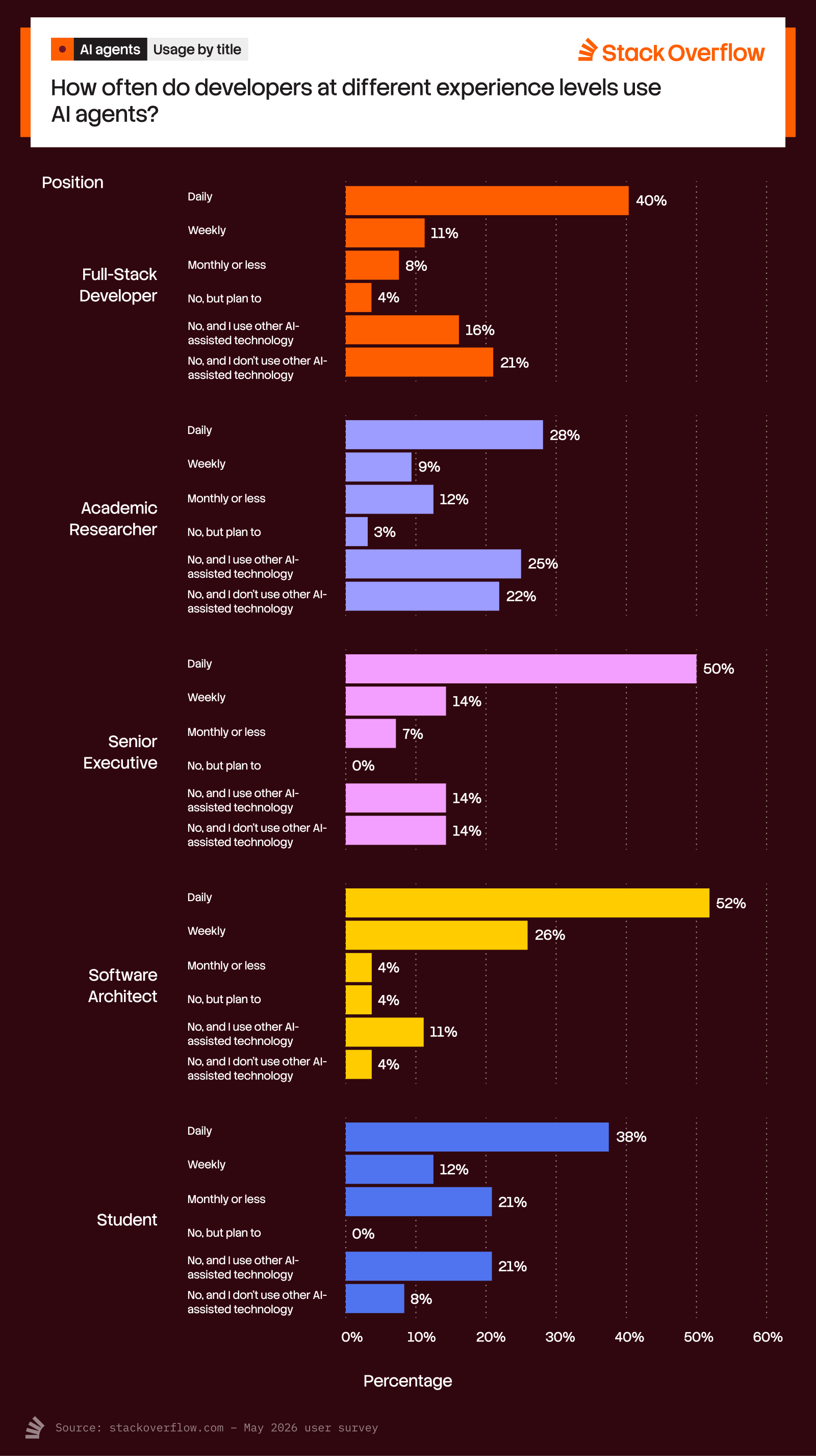
Workplace agent usage has nearly doubled since last year, and it’s not just developers using them. The 2025 Developer Survey showed many developers were using AI but fewer were using agents specifically, with many planning to adopt them. This new survey shows 59% use agents at work at any frequency, compared to 31% in the 2025 Developer Survey. The growth is primarily in daily use, showing how these embedded tools have become a seamless part of many aspects of work. That daily usage is partly driven by developers (40% report daily use), but also architects (52% daily use) and senior executives (50% daily use).
Executive sponsorship is actively shaping the modern enterprise tech stack. The differing results seen with students (38% daily use) and academic researchers (28% daily use) suggest that the absence of typical workplace productivity goals — and continued concern over accuracy in AI output — remains a blocker for those in learning or research-focused settings.
Concerns About Cost Are Fading — Security and Accuracy Are Not
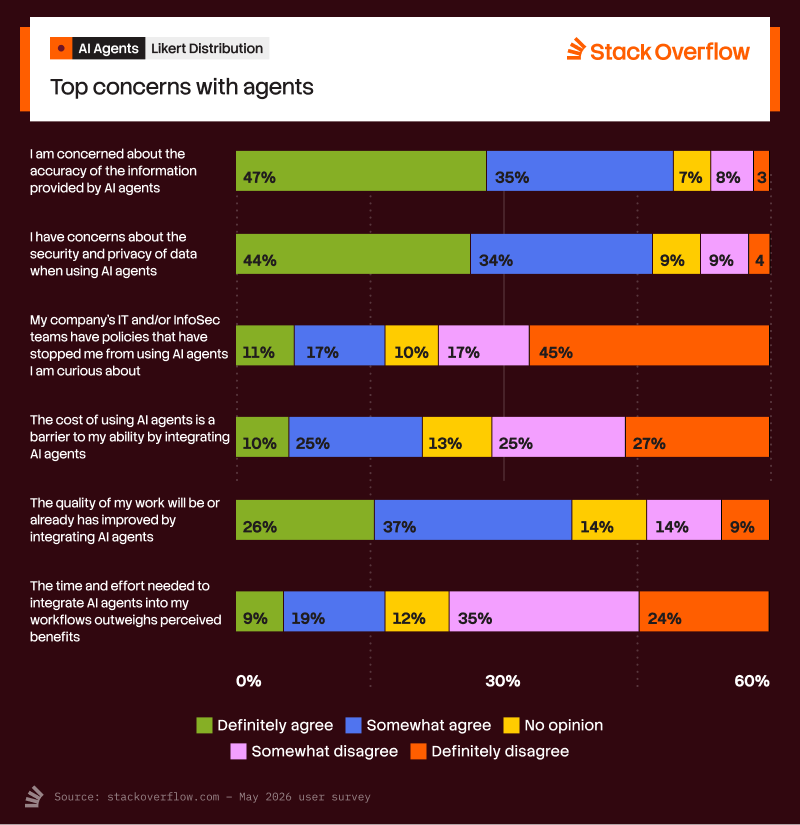
Considering the growth in agents at work, the survey also asked how respondents feel about the typical AI concerns. Executives and engineering managers are the least worried about cost: 75% of executives and 65% of engineering managers disagree or strongly disagree that cost is a barrier to using agents. In the 2025 Developer Survey, 53% of users saw cost as a barrier. That figure has fallen to 38% who agree or strongly agree that cost is a barrier today.
Accuracy and security remain the top two concerns with using agents at work, consistent with findings from last year’s Developer Survey. However, accuracy concerns have decreased from 57% strongly agreeing that accuracy was a barrier for agentic use to 47%. The share of respondents who strongly agree that security concerns are a barrier dropped to 44% from 56%. Architects and students are more sensitive to accuracy and security concerns, while engineering managers are less concerned.

The overall picture from the survey is one of cautious acceleration: agents are becoming embedded in daily work across roles and industries, but the humans overseeing them aren’t stepping back yet. Trust is growing, costs are less of a friction point, and tooling is maturing — but until accuracy and security concerns are fully addressed, most technologists will keep agents on a short leash.