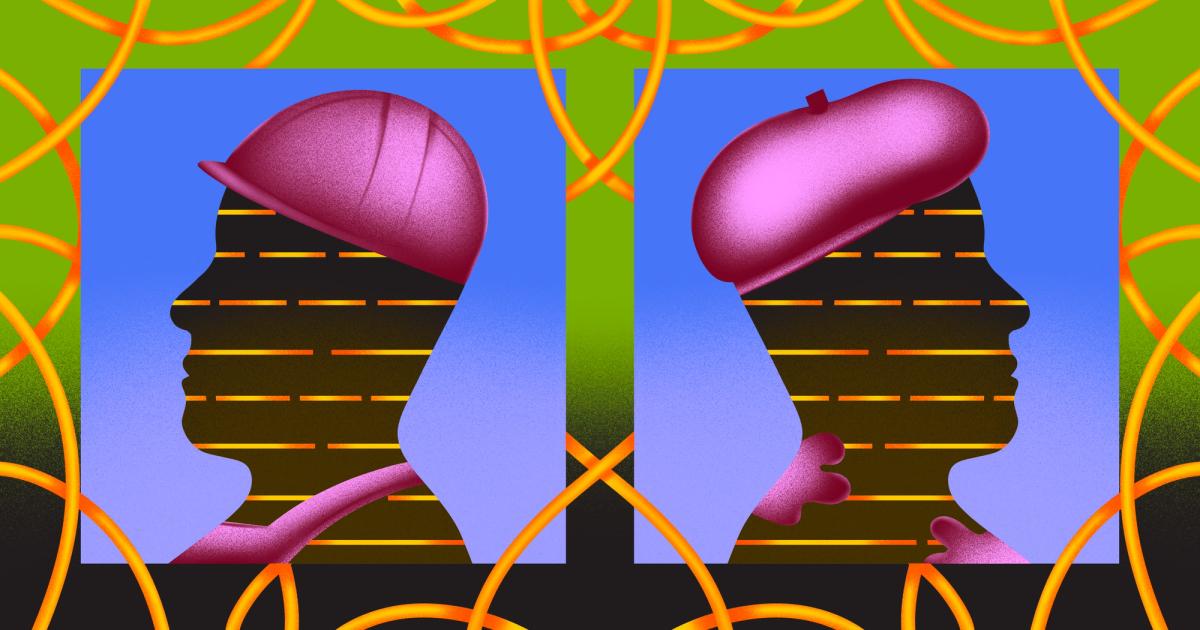
For all of human history, we’ve invented tools to make our lives easier. The spear, the wheel, the printing press, the internet—all of them created by these big brains of ours so we could use our big brains less.
AI is just one invention in a long line that has changed the way we create and consume things. Although where AI will take humanity as a whole is yet to be seen (personally, I rank its current transformative effect somewhere below the internet and above the Kindle), it’s certainly been a radical shift for the tech world. AI tools have shaken up nearly all facets of tech and software—which, some may say, is the bedrock of our modern society—and has changed the way tech workers around the world navigate their everyday tasks and workflows.
This is especially true of how we create code: in 2023, GitHub purported that, of its users, 46% of developers’ code across all languages was generated by GitHub Copilot. As of April 2026, 75% of all the new code at Google is AI-generated. Source? Their CEO’s recent blog post. Google has been pushing this for a while—they went from 25% to 75% in the span of a year and a half. And, you know…nice conveniently round numbers there, Google.
I think we can all agree that a lot of what’s being written is unusable, unsecure, broken bowls of code spaghetti, but still. The sheer number of lines created by AI is growing exponentially at a pace that the mere, mighty human developer cannot keep up with.
While I’ll take the tales of 37,000 lines a day with a grain of salt—although I applaud the tokenmaxxing—it’s safe to say that coding assistants have taken the software development world by storm. As of our 2025 Developer Survey, 84% of developers and technologists have adopted AI, and 51% of them use AI tools daily.
And look, there’s no shame in it—I’ll be the first to admit I used Gemini to research all those stats—but it does raise a few questions for me. First question: What exactly are we creating when we pump out 37,000 lines of code from a mysterious, magical black box called AI? I’m guessing not even the proselytizing CEO who generated that code could tell you.
Second question: What happens when we remove ourselves from the creation process of the things we are creating? Follow-up to that one: Can we even call something fully generated by AI our own creation?
The questions I’m asking are the same philosophical quandaries we’ve been debating amongst ourselves since the first letter was pressed into paper in 1440. Someone somewhere always seems to think new technology is the end of everything forever. And look, someday they will be right about that, but right now they’re only partially correct. Technology is the end of one particular thing: the status quo.
At large, we don’t build our own furniture or handwrite letters to people in our lives. Yet, once upon a time, if you wanted a new chair or to break up with your long distance beau, you’d need to make it and write it yourself. That was the status quo. Nowadays, we have IKEA and WhatsApp, so that status quo has become obsolete. That does not mean either of those art forms—handwriting, woodworking—has disappeared completely. It’s just that we tend to leave those low-tech, old-school crafts to the artisans of the world, who have the patience and care for it. No whittling needed here.
And that word right there, artisan, is at the very heart of our timeless philosophical issue. When technology gives us the souped-up tools to build anything we want faster than ever before, what is the point of being an artisan? Who would construct a chair slowly and by hand when you could put together hundreds of IKEA chairs in the same amount of time? Who is crafting a chair just to craft a chair? Who is writing code just to write code when an AI can build you anything you want in half the time?
The Artisan vs. Builder Dichotomy
The artisan vs. builder dichotomy is central to the discourse around AI tool usage happening in developer communities. Recently, Mike Swift from Major League Hacking told us that coding assistants are causing a “paradigm shift” in the world of software development, changing the way developers work, how fast they build, and how they understand their identities. “Historically, being a developer was an identity because you had to know the craft to do it,” Mike said. “That’s not necessarily true anymore.” And let’s not forget, this identity-destruction was actually one of the promises of AI—now, you can be a coder, a video editor, a writer, a mathematician, or a designer, all without ever having to learn how to be one. Barring stand-up comedy, AI has lowered the barrier to entry for nearly every craft. Heck, it can even diagnose diseases, although you really should not make ChatGPT your primary care provider.
For better or for worse, we’ve created endless shortcuts for ourselves with AI. Now, for the low, low price of $20 a month, you can offload your learning, your work, your interpersonal relationships, and even your health decisions to a chatbot. This offloading is especially true for how we build software, where workers are asked to build, build, build as fast as they can. Companies don’t want artisans whose slow, meticulous work produces the finest quality products the market could ask for. No, they need people in seats now. They want builders who can put together hundreds of IKEA chairs in minutes.
AI coding assistants are a convenient, efficient way for anyone to build at lightning speed, no craftsmanship required. But IKEA chairs aren’t built to last, and neither is AI-generated software. What’s going to happen when companies break their poorly fabricated chairs and AI-generated software?
Truthfully, I don’t think the artisan vs. builder dichotomy needs to be a dichotomy. With AI, we’ve reached yet another inflection point in our history of technical advancements, one that ends the current status quo and creates a new one—one where developers evolve into artisans who build the future of tech with speed and at scale.
What Developer Identity Now Requires
Before we can talk about building-artisans and artisanal-builders, it’s important to dissect why developer identities need to evolve. But first, let me talk about myself.
I’ve never claimed to be an experienced developer, nor have I ever claimed to know much about tech at all (besides that one time during my Stack job interview where I pretended to know a lot about AI to impress my future coworkers). I’m quite loud and proud about being a bright-eyed, bushy-tailed beginner at code. Yet, with the power of AI coding tools in my hand, I’ve been able to build fully-working (okay, partially working) applications in just a few hours.
I wouldn’t call myself a builder or an artisan in this regard (I like to identify as tech ingénue), but I know for a fact there are plenty of people who would call themselves software builders now who use vibe-coding tools. How do I know this? They put stuff like, “building the next XYZ” as their LinkedIn headers without knowing a lick of code. This is not to knock these ambitious movers and shakers—I know it takes real grit and guts to build something on your own—but their status as software builders questions how necessary it really is to know a lick of code. You, too, can be a builder of software today. But what does that mean for the builders of software from years past?
AI has made the art of coding by hand purely optional, if not entirely obsolete. But what is a developer if not someone who writes code? There’s that paradigm shift Mike Swift was talking about. Developer identities can no longer be defined in contrast to non-coder identities—it’s no longer about who can build software and who can’t. Anyone with a Claude subscription (including me) can do it. The important, identifying question then becomes: what makes developers indispensable to the software building process?
That indispensability comes from developers’ years of experience—their artisanry. If you can take that artisanry and build with it, you’ve got a golden ticket.
What Artisanry Actually Looks Like
I’ve experienced this myself as a writer. If AI is good at generating code, it’s even better at writing prose.
In the early days of AI, when people figured out that feeding a bot a non-specific, four-word prompt could get you back multiple paragraphs of sensible writing, suddenly everyone was a writer. People with no experience could produce content comparable to my own. So much for honing your art, huh? Being a writer was no longer about being able to write. Articulate, thoughtful paragraphs with big words and poignant metaphors had become all too commonplace. Anyone with a Claude subscription (including you) could do it. If being a good writer isn’t presupposed on writing well, what did I have to prove I was a card-carrying writer?
Well, once all the hoopla around AI-generated writing faded and people got sick and tired of the rules of threes and em dashes and contrasting statements, writing became a craft again. If you wanted to be a writer in an AI world, you couldn’t just present some pieces of writing as proof—you needed to tell a good story, one that affects and engages people. That, it turned out, was the real value of my years of artisanry. And hey, those specific qualities of my artisanry are easy to build with because, AI-assisted or not, my skills as an artisan shape what I build. Because I actually know how to craft a high-quality story with my own two hands, AI really does help me write with speed and at scale, allowing me to keep up with builders who want to move faster than my fingers can type. Because I’m willing to wield my craft in this way, I get to use my artisanry to help build things I really care about, working in tandem with fast-paced builders to write things that are real and meaningful. In other words, I’m the woodworker who helps IKEA design better chairs.
Developers have the same opportunity—to become that artisan asset in a builder world. The value of a developer is no longer simply the ability to write code; it’s the accumulated judgment, taste, and craft that determines whether what gets built is actually worth building. In a world where anyone can generate software, the developers who understand the craft deeply are the ones who will shape what that software becomes.