I’ve been recruiting into Stack Overflow’s product and engineering teams on and off since 2015, having originally joined when we were focused on our Careers product, and returning in 2021 to help build the teams behind products like Overflow AI, Stack Internal, and more. I feel uniquely placed to offer some perspective on just how much hiring has changed in the last 11 years, both as a talent professional and someone who’s spent most of their career doing that here at Stack Overflow.
The Resume Problem
The short take is that it’s gotten exponentially harder to identify talent that’s a good fit for our teams at the top of the application funnel. Part of that is down to there being proportionately more people actively looking for new roles as the market has shifted from candidate-led to employer-led. Part of it is due to the emergence of new roles within machine learning and data science that didn’t exist ten years ago, with lots of talented people moving into these exciting new areas. However, it would be remiss of me not to acknowledge that a big part of the problem is that, thanks to AI, bad actors, and higher-than-ever distrust on both sides of the fence, the traditional resume no longer gives me trusted information about what qualifies someone as a good fit for Stack Overflow. It also means there’s more pressure to add more stages to what can already be long and convoluted hiring processes, just to be completely certain that someone can do what we need them to do — in the right place, at the right time, with the right intentions.
We recently posted a job for a Staff Data Scientist on our careers page and within 24 hours had received over a thousand applications. This is not a new phenomenon and has been standard for us and many other companies over the last few years. What did stand out this time, however, was just how similar some of the resumes were:
- We received multiple applications formatted identically, with the same basic overview of each candidate’s experience and very little to tell them apart from one another.
- Large numbers of resumes included links to social media profiles that didn’t exist, or listed candidates as working at companies that didn’t exist at the time they purported to work there.
- Despite including application questions to glean more information from interested applicants, the popularity of tools like ChatGPT meant we received essay-length responses that didn’t really answer the questions. Anyone can paste those questions into an AI model and copy the output over, but that makes it harder to tell if someone took a shortcut or isn’t who they claim to be — and it makes everyone sound like the same person. It’s the “new Star Wars Trilogy” problem: if everyone’s Han Solo, no one’s Han Solo.
A System Under Pressure
We’re a small team on the talent acquisition side at Stack. For one recruiter to work through this volume of either needlessly detailed or not-detailed-enough information makes it markedly harder to discern who deserves early investment in the process. It’s no secret that talent teams are increasingly under-resourced across the industry, and yes, there’s a growing reliance on AI at the sourcing stage to reduce time-to-hire. But increased suspicion from candidates about what happens to their resume once they hit “apply” means that no one’s happy. Candidates feel pressure to format their applications to bypass AI screening models that may or may not exist depending on the company, while recruiters grow increasingly suspicious about the validity of who they’re speaking to once they reach out. The system is broken, and as of yet, there’s no real solution.
Rethinking It with Developer Story
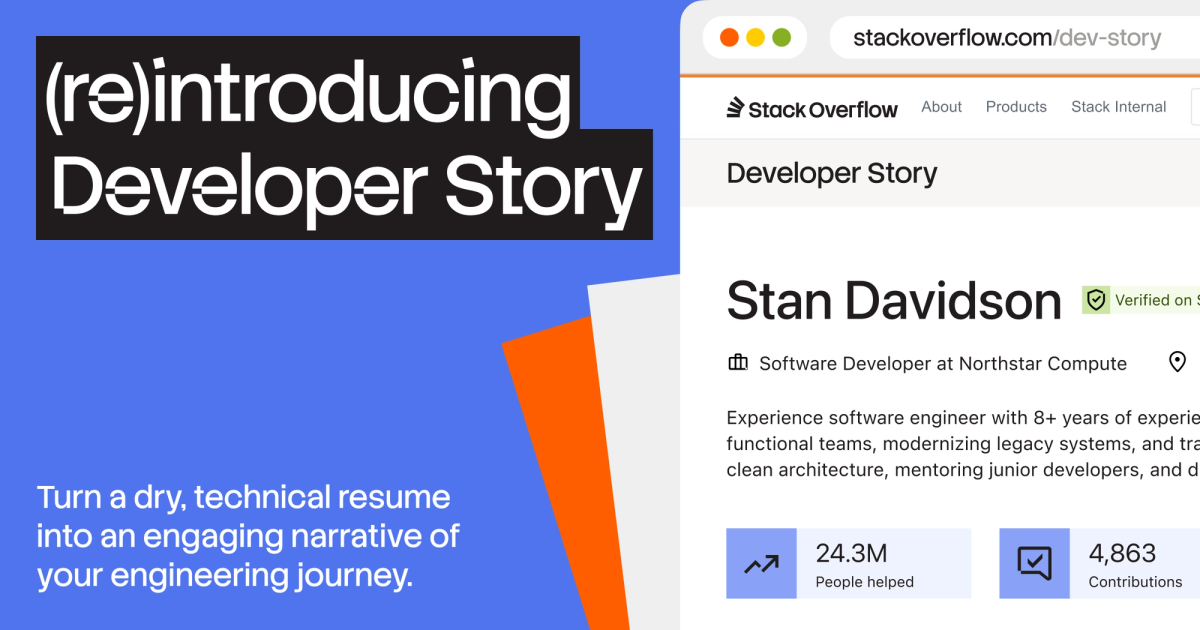
That’s why, when the product team here decided to resurrect the Developer Story, I was first in line to offer input on how it could benefit everyone in the hiring process. I know what I’d love to see in a resume to help me decide whether to schedule a first call with someone who reads like a fit. If we can take that instinct and combine it with nearly 20 years of experience helping technologists learn, support each other, and grow their careers, we could make a real difference.
Our vision for Developer Story is that it will be a way for anyone to showcase their work, their expertise, and their impact — whether in our community or in their career. Rather than guessing what employers are looking for, we want to leverage our experience and history to make sure you’re presenting the information we know they want to see. On the employer side, Developer Story focuses attention on the information that matters when hiring for a new position, giving recruiters more objectively verifiable insight into the person behind the resume and hiring managers a chance to see where someone’s past work overlaps with what they’ll be doing next.
Even if you’re not looking for a job, Developer Story can be your place to collate and showcase everything you’ve worked on throughout your career and personal projects. That weekend app you built to time the perfect boiled egg? Put it in. That time you found the bug that was halting production at the last minute? That can go right alongside it. A full picture of your journey through technology, ready to tell your story when the time comes.
Developer Story is an attempt to fix what’s broken within one part of the hiring process, while making sure everyone gets a chance to stand out and show the world what they’ve built, what they’ve learned, and what they’re going to do next. You can get started at stackoverflow.com/developer-story.