Your organization has spent years building valuable knowledge — the kind of specific data that makes or breaks the daily work of your teams. But that work is now spread across more surfaces than ever: AI tools, Slack conversations, documents, coding environments, and private sessions. You’re moving faster because of AI, which means you’re also accumulating more data than you can keep up with.
It’s not just hard for your people to track — it’s hard for your agents too. Which document is current? Which answer is actually right? Agents are asking the same questions your teams are, just faster, and with far more confidence than the answer deserves. If you’re still treating your data like business as usual, much of the context your team creates will collect dust across your distributed tools.
Agents are being pushed into production with stale, conflicting, and missing information, executing historical mistakes confidently at speeds human teams can’t match. To compensate, humans end up in every loop, double-checking agent output — costing time, efficiency, and tokens. Meanwhile, your team’s valuable solutions disappear instead of becoming reusable organizational knowledge.
Stack Internal’s new platform experience is designed to fix that.
What Stack Internal Does
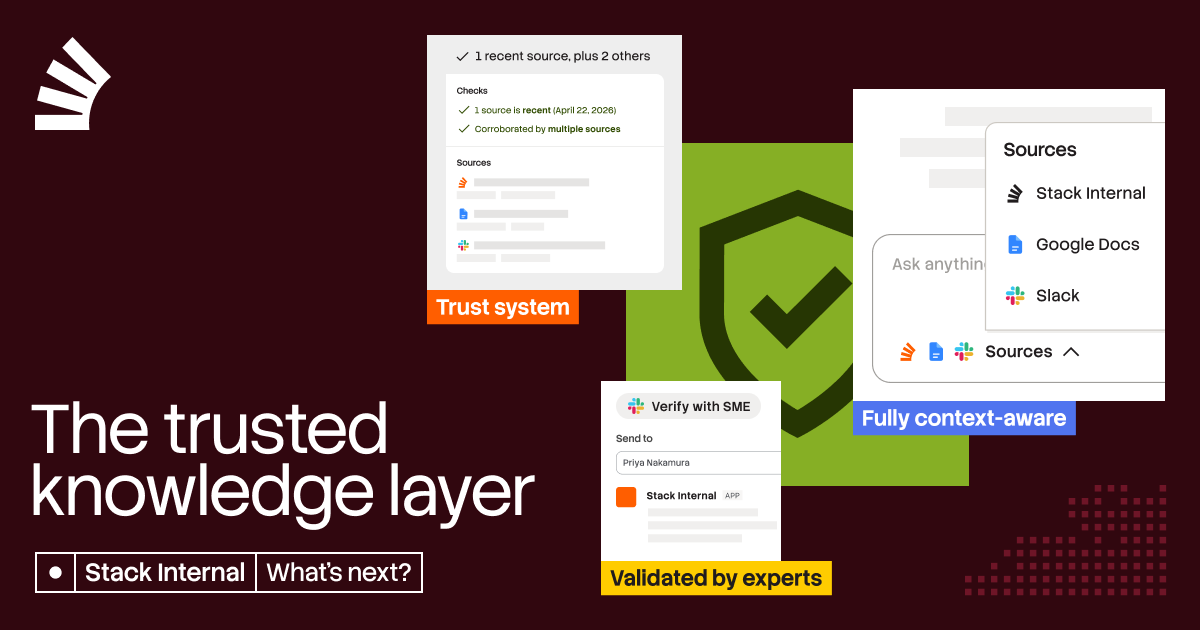
The new Stack Internal platform is an AI-native knowledge platform that fits within your existing infrastructure and delivers decision-grade knowledge across your organization. It turns your team’s solutions, discussions, and outcomes into validated knowledge that benefits the next person — or agent — who needs it. When knowledge management becomes a byproduct of the work itself rather than a separate chore, information silos break down and agents start producing reliable, autonomous results.
Rather than simply retrieving information that might be relevant, Stack Internal determines whether that information is reliable, current, authoritative, and safe to use. It automatically ingests knowledge across sources, evaluates it for trust, and delivers it to your teams and agents whenever and wherever they need it. Even as an enterprise’s underlying AI models, applications, and systems change, Stack Internal keeps context fresh — creating a persistent, durable knowledge layer for all your work.
What’s Included in the July Release
Automatic Knowledge Ingestion
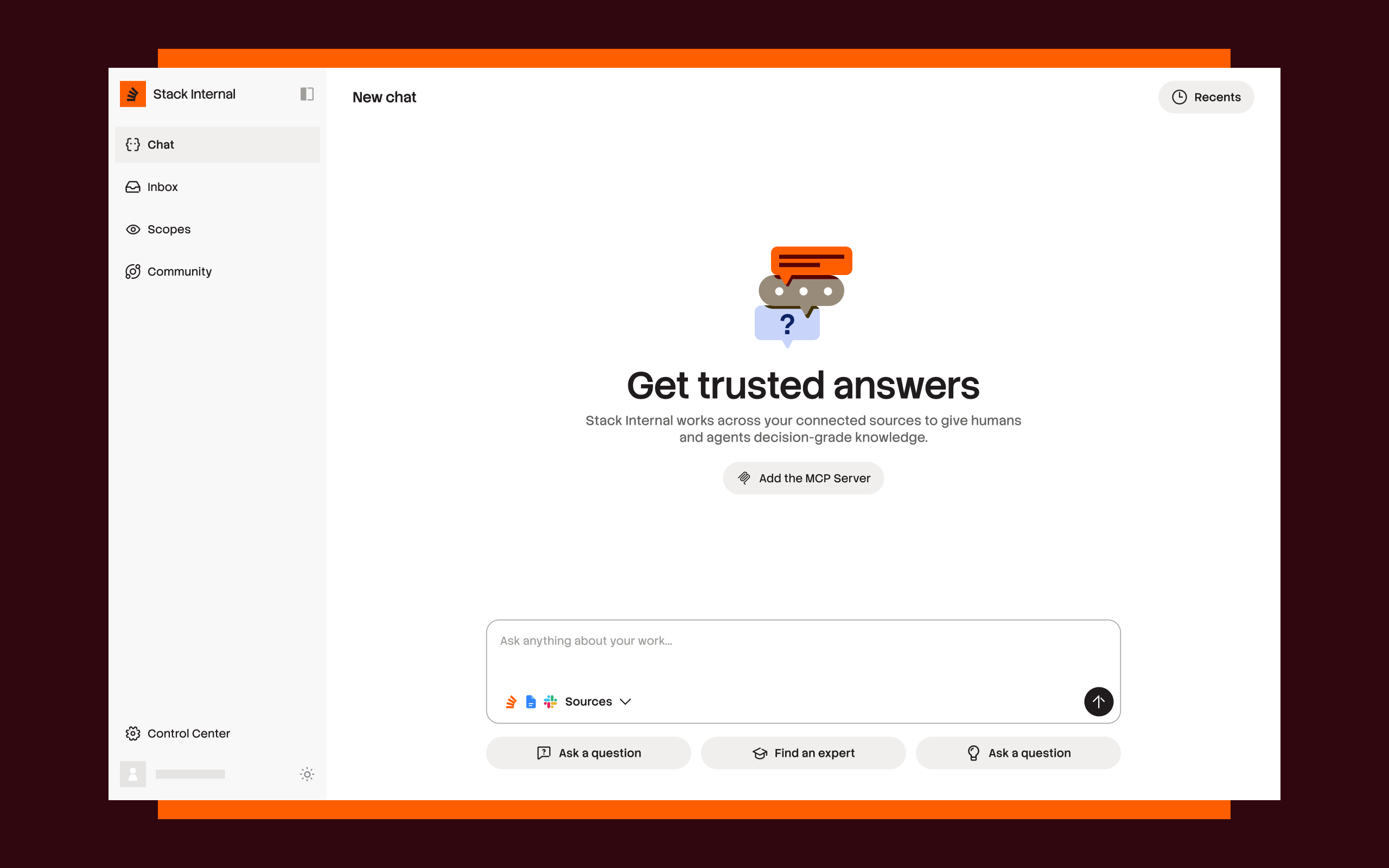
The platform automatically builds and maintains a source of truth from knowledge created across your organization. The July release introduces automatic ingestion that breaks raw data into durable stored knowledge. Initial connectors include Stack Internal community, Google Docs, and Slack — slicing, storing, and evaluating content for trust.
Decision-Grade Chat Interface
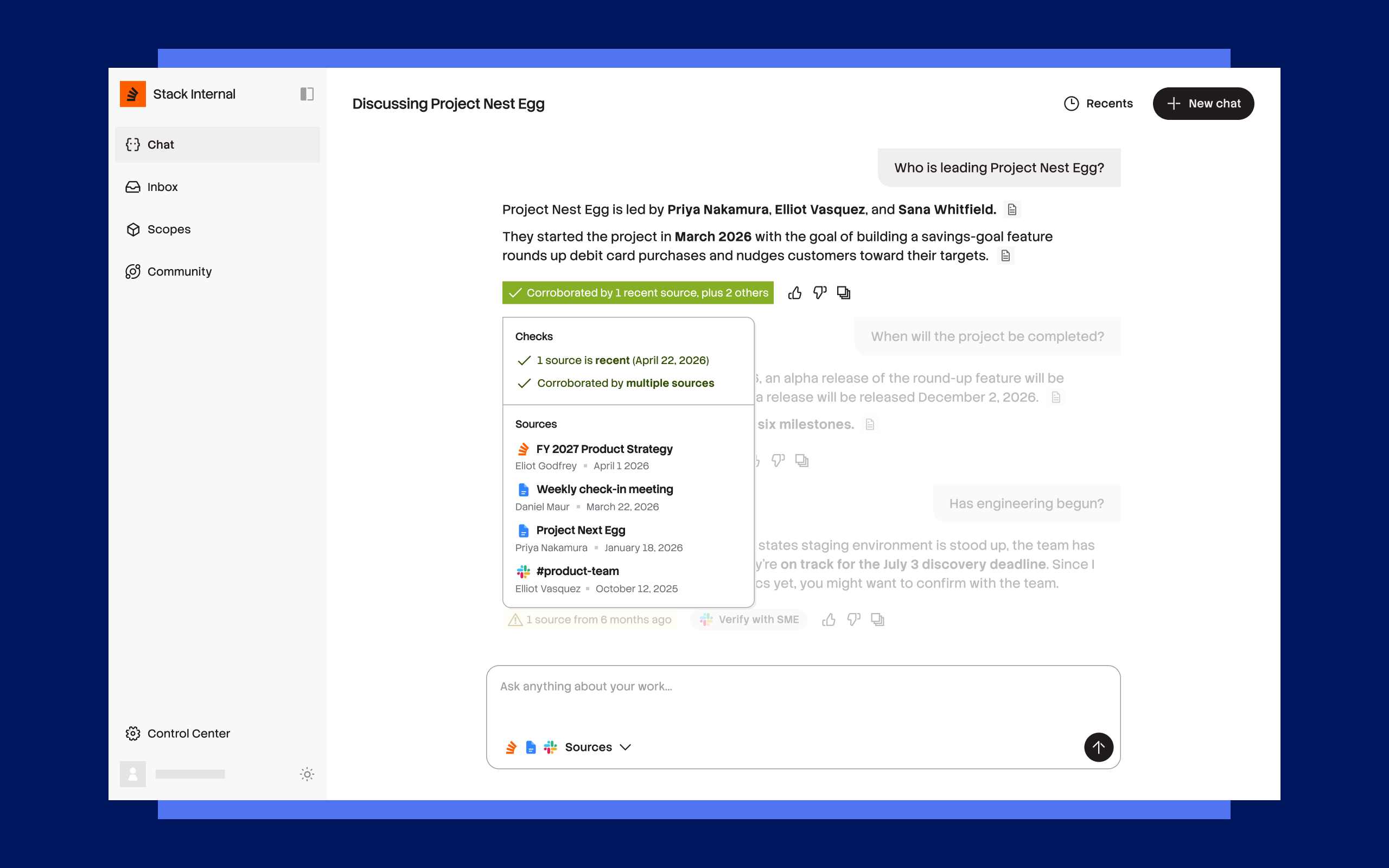
A new chat interface includes response-level confidence labels and provenance cards so there’s never ambiguity about where information came from or how much it can be trusted.
When Stack Internal detects a gap in existing knowledge, it will automatically route questions to domain experts for verification (coming soon). API and MCP server integrations are also available to streamline AI agent context retrieval in-flow, wherever work happens.
Agent-First Permissions
AI agents are treated as first-class citizens with compliant, explainable, and permission-aware knowledge access. Agents operate within the same permission boundaries as humans to prevent unauthorized data access, and identity-aware data boundaries across all surfaces mitigate security risks and data leakage.
API Analytics via Swagger v3
With new Swagger API (v3) endpoints, engineering leaders can query precise metrics on internal API usage. This includes breaking down call volumes by specific internal applications to monitor high-traffic dependencies, comparing API V2 and V3 adoption, and gaining comprehensive visibility into how community knowledge is consumed.
The Compounding Knowledge Advantage
The more your teams work, contribute, validate, and reuse knowledge, the more valuable your organizational memory becomes. Your existing knowledge base earns compounding returns — building the reliable, reusable context that teams and AI tools need to succeed. This virtuous cycle maximizes your AI investment, improves reliability, and helps teams move faster without added work or token spend.
What’s Coming Next
Future releases will include additional connectors for popular software and workspaces, machine-facing trust scores, conflict and decay detection, enhanced knowledge capture and synthesis, and more.
Getting Started
Current Stack Internal customers can test these new capabilities starting today, July 30, 2026. Admins can follow this getting started guide or contact their Stack Internal account representative to begin the free trial. Full release notes are available here.
If you’re not yet a customer but want to explore the platform, you can learn more about Stack Internal and talk to an expert.